 Accounting Flow
Proposals, priced properly
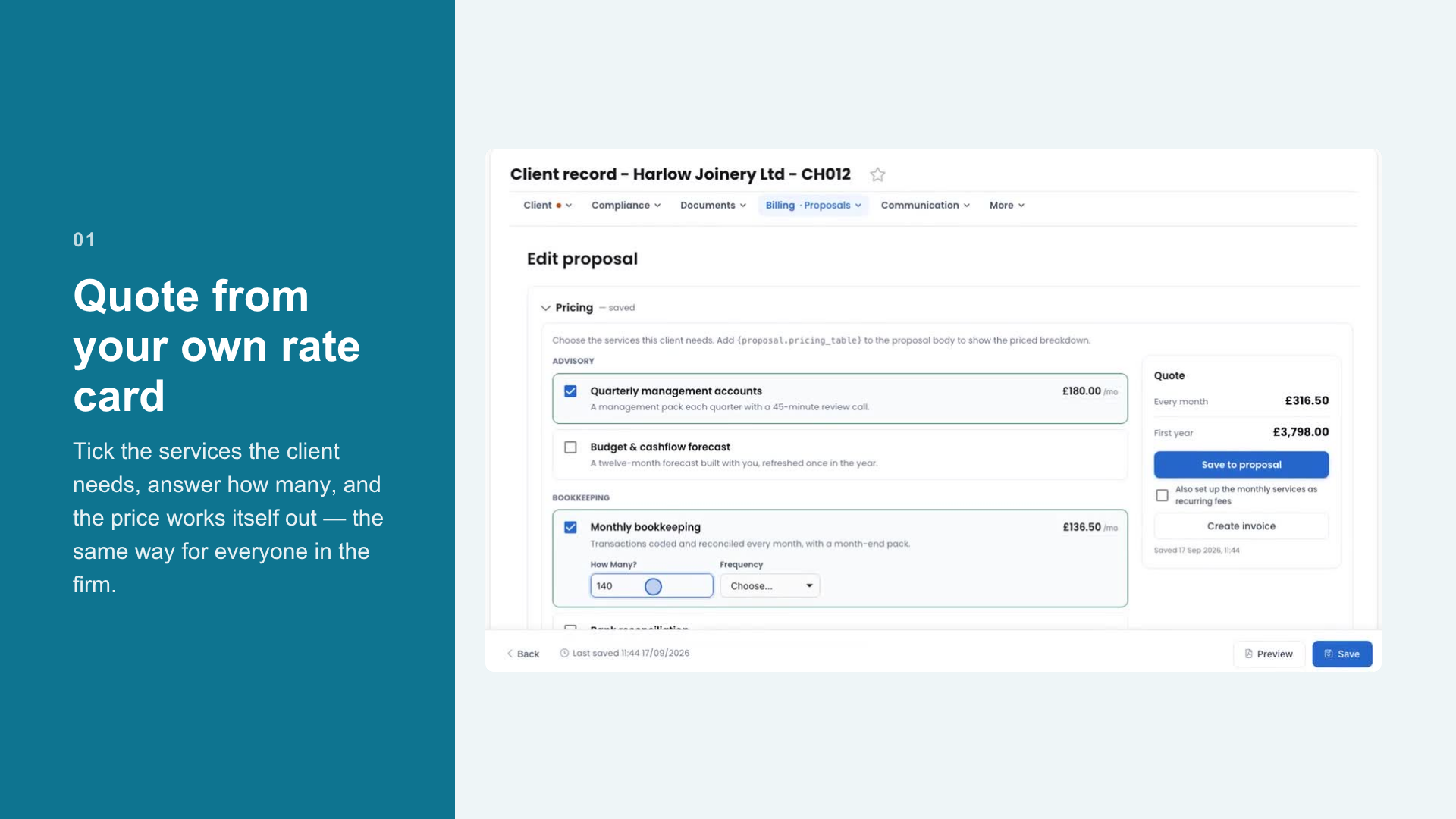
Quote from your own rate card instead of a spreadsheet. Tick the services a client needs, answer how many, and the price works itself out the same way for everyone in the firm.
Pricing is where a lot of firms quietly lose money, and it usually is not because the rate card is wrong. It is because the rate card lives in a spreadsheet on one partner's machine, and the quote that went out on Tuesday was built from memory.
One rate card, used the same way by everyone
Set your services and their prices once. When someone builds a proposal they tick the services the client needs and answer the questions that drive the price — how many transactions, how many payslips, how many directors — and the figure assembles itself. The same inputs produce the same quote whoever is at the keyboard.
And then the fee you actually agreed
Nobody wins every negotiation at list price, so there is a deliberate escape hatch: type the fee you agreed straight over the top. The list price stays visible next to it. That sounds like a small detail and it is the whole point — at the end of the quarter you can see what you quoted, what you settled for, and the gap between them, instead of a set of numbers that have silently become the new rate card.
The client says yes online
Proposals go out to be accepted in the browser, and the record of what happened comes back to the client file: what was sent, when, what they agreed to. No hunting through a mailbox to establish what was actually signed.
Whether you are winning
The pipeline report answers the two questions worth asking about proposals — what is outstanding, and what proportion you convert. Both are hard to know when quotes live in individual inboxes, and both change how you price the next one.